Guide to Hair Transplantation Procedure and Costs in Thailand
If you have been quietly watching your hairline shift, noticing more hair on your pillow than you would like, or losing confidence in photographs, you are not alone — and you are certainly not without options. Hair transplantation in Thailand has become one of the most sought-after medical procedures among both Thai nationals and international patients, and for very good reason.
This guide will walk you through everything you genuinely need to know: how each procedure works, how clinics calculate the cost, what a realistic price range looks like in 2026, and — just as importantly — when a transplant is the right choice versus when a non-surgical medical programme may deliver better, longer-lasting results.
Understanding Hair Loss Before You Consider a Transplant
Hair transplantation is a surgical solution, and like any surgery, it works best when performed on the right candidate atthe right time. That is why the first step at any reputable hair restoration clinic is never a quote — it is a thorough assessment.
The most widely used classification for male hair loss is the Norwood Scale (Grades I–VII), while female hair thinning is assessed using the Ludwig Scale (Grades I–III). Understanding where your hair loss currently sits on these scales is essential, because it determines:
-
Whether you have sufficient donor hair (hair at the back and sides of the scalp that is genetically resistant to shedding) to achieve natural-looking coverage
-
Which transplant technique is best suited to your hair type, density, and scalp condition
-
How many grafts will be required — which is the primary driver of your overall cost
A proper assessment uses trichoscopy (microscopic scalp imaging), AI scalp analysis, and sometimes a blood panel to identify underlying causes of hair loss such as hormonal imbalance, nutritional deficiency, or autoimmune conditions that could affect both transplant outcomes and long-term hair health.
The Two Main Hair Transplant Techniques Available in Thailand
FUE — Follicular Unit Extraction
Follicular Unit Extraction is currently the global gold standard for hair transplantation and is the most commonly performed technique in Thailand's premium clinics.
How it works: Individual follicular units (each containing 1–4 hair follicles) are extracted one by one from the donor area — typically the back and sides of the scalp — using a micro-punch tool with a diameter of 0.6mm to 1.0mm. Each extracted graft is inspected, prepared, and then implanted into tiny recipient sites made in the thinning or bald area.
Key characteristics of FUE:
-
No linear scar — only tiny circular micro-marks that are essentially invisible once healed
-
Suitable for patients who prefer short hairstyles or who have limited scalp laxity
-
Recovery is faster than older strip methods, typically 7–10 days before returning to normal activity
-
Graft survival rate of 90–95% when performed by an experienced team
-
Sessions typically last 6–10 hours depending on graft count
FUE is most suitable for:
-
Norwood Grade II–V hair loss
-
Patients with good donor density at the back of the scalp
-
Eyebrow or beard transplantation
-
Scar concealment (including previous FUT linear scars)
DHI — Direct Hair Implantation
Direct Hair Implantation is an evolution of FUE that uses a specialised pen-shaped implanter device (the Choi Implanter Pen) to extract and implant grafts in a single motion, without the need to pre-make recipient sites separately.
How it works: Each extracted graft is loaded directly into the Choi pen tip and implanted immediately into the scalp at a precisely controlled depth and angle. Because grafts spend less time outside the body, DHI is associated with higher graft survival rates in experienced hands.
Key characteristics of DHI:
-
Allows more precise control over hair direction, angle, and density — particularly valuable for the hairline
-
Grafts are out of the body for a shorter period, reducing oxidative stress on the follicle
-
No shaving required in the recipient area (unshaved DHI), making it discreet for patients who cannot take extended leave
-
Slightly longer procedure time per graft compared to standard FUE
-
Generally priced higher than FUE due to technique complexity and consumable cost
DHI is most suitable for:
-
Patients prioritising a highly natural hairline design
-
Those who want to avoid shaving the recipient area
-
Patients with moderate hair loss (Norwood II–IV) where density enhancement in existing hair is needed
-
Professionals who need to return to a public-facing role quickly
How Hair Transplant Cost Is Calculated in Thailand
This is the question almost every patient asks first — and it deserves a detailed, honest answer.
Unlike many cosmetic procedures that are priced as a fixed package, hair transplant pricing in Thailand is almost universally calculated per graft. Understanding this system puts you in full control of what you are comparing when you receive quotes from different clinics.
The Per-Graft Model Explained
One graft equals one follicular unit — a naturally occurring grouping of 1 to 4 individual hair strands that share a single root structure. When clinics quote "2,000 grafts," they mean 2,000 of these follicular units, which may represent anywhere from 3,000 to 7,000 individual hairs depending on the graft composition.
Approximate graft counts by hair loss grade (Norwood Scale):
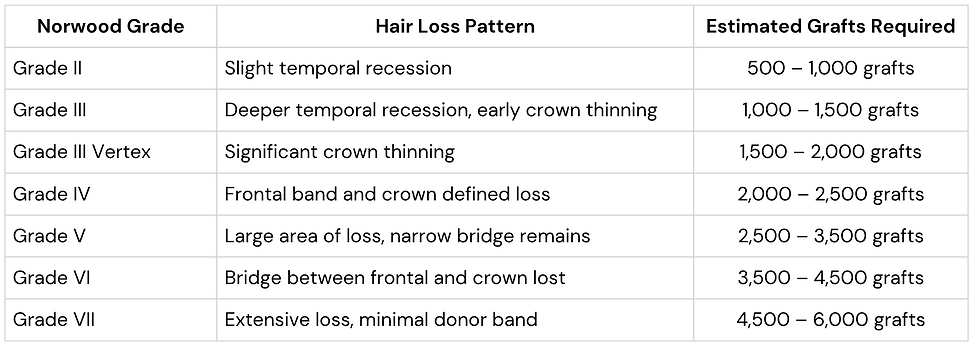
Note: These are estimates only. Actual graft requirement is determined at assessment based on individual scalp area, hair calibre, donor density, and desired coverage.
Approximate Hair Transplant Price Ranges in Thailand (2026)
Pricing varies meaningfully based on the clinic's tier, the experience of the operating surgeon, the technique used, and what is included in the package. The following ranges reflect Thailand's premium medical hair clinic segment:
FUE Hair Transplant (per graft):
-
฿35 – ฿65 per graft at mid-tier clinics
-
฿65 – ฿120 per graft at premium / doctor-led specialist clinics
DHI Hair Transplant (per graft):
-
฿80 – ฿150 per graft at premium clinics
Illustrative Total Cost Estimates (FUE, Premium Tier):
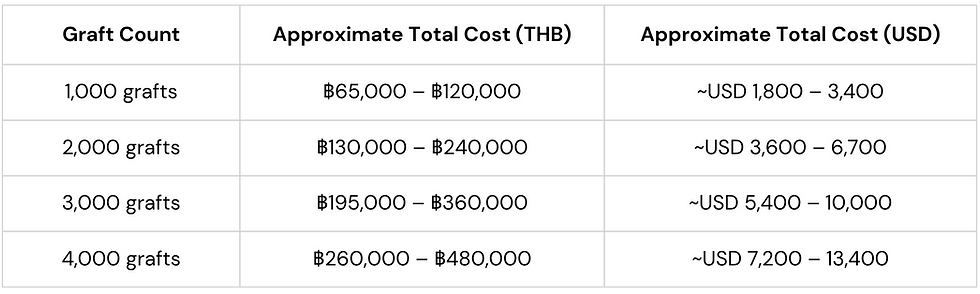
Thailand's combination of competitive pricing, internationally trained surgeons, and world-class private clinic environments makes it one of the most compelling destinations globally for hair restoration.
The Recovery Timeline: What Happens After a Hair Transplant
Understanding recovery is as important as understanding the procedure. Managing expectations correctly is what separates a patient who is delighted with their result from one who panics unnecessarily at 6 weeks.
Week 1–2: Healing phase Small scabs form around each implanted graft. This is entirely normal and expected. Avoid touching, scratching, or exposing the scalp to direct sun. Sleep with your head slightly elevated to reduce swelling. Gentle washing is introduced from Day 3–4 per your clinic's protocol.
Week 2–4: Shock loss phase This is the stage that catches many patients off guard. The transplanted hairs shed — and so may some surrounding native hairs. This is called telogen effluvium or transplant shock, and it is a completely normal part of the process. The follicle root remains intact beneath the surface; only the hair shaft is shed. The follicle enters a rest phase before beginning new growth.
Month 2–3: Dormant phase Very little visible change. This is the phase where patience is genuinely required. The scalp looks similar to or slightly worse than before the procedure. Trust the process.
Month 4–6: Early growth New fine hairs begin emerging from the transplanted follicles. Growth is typically patchy at this stage — some areas emerge earlier than others. Hair texture may initially be finer or slightly curly before normalising.
Month 8–12: Significant growth The majority of transplanted hairs are now growing. Density visibly improves. This is when most patients begin to truly appreciate the result.
Month 12–18: Final result The full transplant result is visible. Hair calibre has normalised, density has reached its maximum, and the hairline design can be fully evaluated.
Ready to Understand Your Options?
Planning hair restoration from abroad means placing an enormous amount of trust in a team you have not yet met in a city you may never have visited. We take that trust seriously. Premier Serene was built specifically to support international patients through this process — with transparent communication in your language, specialist assessments that can begin before you travel, complete cost breakdowns with no surprises on arrival, and a concierge support team that coordinates every detail of your Bangkok journey. Patients from across Asia, the Middle East, and beyond choose Premier Serene not because we are the loudest voice in the market, but because we are the most reliable one.